phudina :
Morphology:
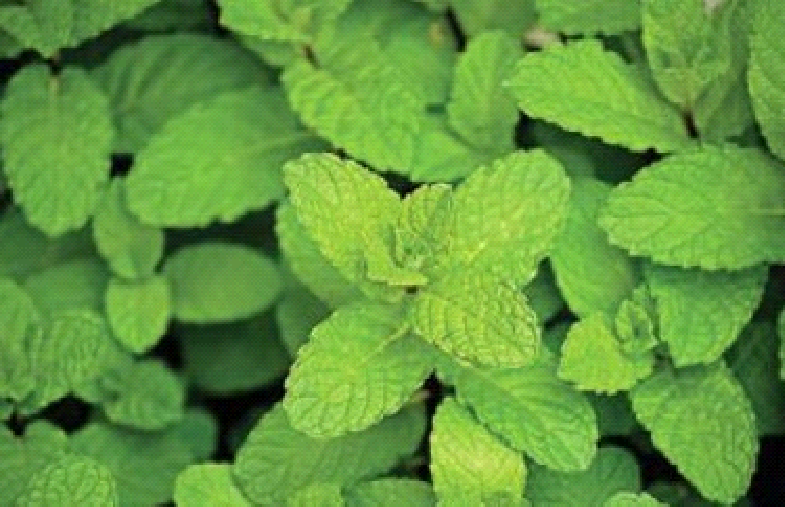
Peppermint was first described in 1753 by Carl Linnaeus from specimens that had been collected in England; he treated it as a species, but it is now universally agreed to be a hybrid. It is a herbaceous rhizomatous perennial plant that grows to be 30–90 cm (12–35 in) tall, with smooth stems, square in cross section. The rhizomes are wide-spreading, fleshy, and bear fibrous roots. The leaves can be 4–9 cm (1.6–3.5 in) long and 1.5–4 cm (0.59–1.57 in) broad. They are dark green with reddish veins, and they have an acute apex and coarsely toothed margins. The leaves and stems are usually slightly fuzzy. The flowers are purple, 6–8 mm (0.24–0.31 in) long, with a four-lobed corolla about 5 mm (0.20 in) diameter; they are produced in whorls (verticillasters) around the stem, forming thick, blunt spikes. Flowering season lasts from mid- to late summer. The chromosome number is variable, with 2n counts of 66, 72, 84, and 120 recorded. Peppermint is a fast-growing plant; once it sprouts, it spreads very quicklyHistology:
Leaf anatomyLeaves being the most important part from which oil is extracted, the anatomical characters are relevant. Upper epidermis composed of large, clear epidermal cells with sinuous, vertical walls and possessing few or no stomata, few glandular trichomes present; palisade parenchyma, comprising a layer of columnar cells rich in chloroplasts; spongy parenchyma, of 4–6 layers of irregularly shaped chloroplastid- containing cells and intercellular air-spaces. Lower epidermis of small epidermal cells with sinuous, vertical walls and numerous diacytic stomata; in the region of veins and midrib, exhibits non-glandular and glandular trichomes as outgrowths; non-glandular trichomes uniseriate, papillose, 1–8-celled; glandular trichomes have 1–2-celled stalk and 1–8-celled glandular head containing the essential oil. Calcium oxalate crystals absent
- » Classification and names of phudina
- » Synonyms and definitions of phudina
- » Drug Properties of phudina
- » Chemical Constituents of phudina
- » Standardization of phudina
- » Parts used and Dosage of phudina
- » Morphology and Histology of phudina
- » Distribution and Conservation of phudina
- » Cultivation of phudina
- » phudina in the market
- » Medicinal Uses of phudina
- » Researches and clinical trails of phudina
- » phudina in other sytems of medicine
- » Ayurvedic formulations with phudina
- » Images of phudina

Website Administrator
This article is incomplete. If you feel you can make a contribution, please let us know by sending email to mail@ayushvedah.com, we may consider your request. Thank you.